 Collection Pan Arab Luxury Magazine
Related Articles
There is a moment in the lifespan of a great collection when experimentation gives way to conviction, when a material once tested cautiously on components and limited editions becomes so intrinsic to the character of a watch that its absence would feel like an omission. For the Overseas of Vacheron Constantin, that moment arrived quietly in titanium, and it is now impossible to imagine the collection without it.
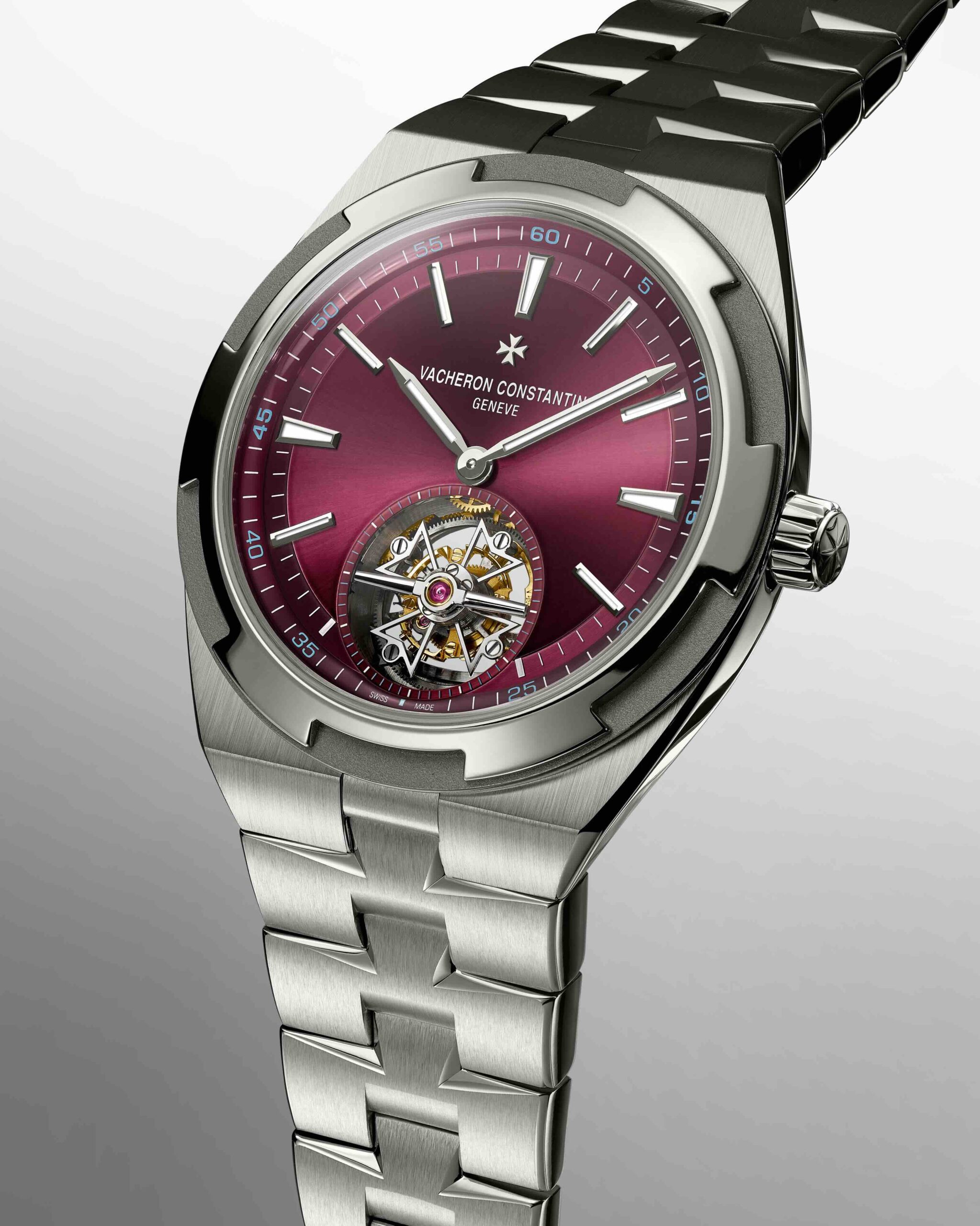
The new Overseas Tourbillon, presented under a February embargo that lifted with the winter light over the Jura, is a synthesis and a convergence of the ultra-thin calibre 2160, a deep red dial that recalls lacquerwork and embers, and a metal whose relationship with the Maison has deepened over fifteen years into something approaching symbiosis.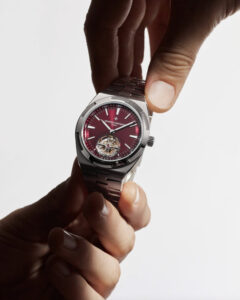
Let us begin with the case, because it is here that the watch announces its intentions. Grade 5 titanium, 42.5mm in diameter, just 10.39mm thin. The figures are impressive, but they do not convey the sensation of lifting the watch for the first time. Titanium is 30% stronger than steel and half its weight, yet such statistics feel clinical beside the experience of a timepiece that seems to forget itself on the wrist. The Overseas has always been designed for movement, for the traveller, the explorer, the individual who does not remove their watch at the day’s end but wears it through time zones and evenings.
The finishing, too, deserves attention. Vacheron Constantin has resisted the temptation to treat titanium as a merely utilitarian material. The bracelet links are polished at their angles, vertically satin-brushed on their faces, catching light in a manner that elevates the metal beyond its aerospace associations. The bezel, its profile an echo of the Maltese cross, rests on a sandblasted ring with circular satin-brushing that softens the technicality beneath. It is a lesson in restraint: every surface considered, nothing overstated.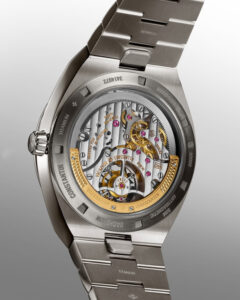
Deep red, The Maison calls it such, though the colour shifts with the light, crimson in shadow, almost vermilion when the sun catches the sunburst satin-brushing. Vacheron Constantin has, in recent years, demonstrated a quiet mastery of colour: the green of the Everest models, the pink of certain women’s references, the gold dials that arrived with quiet confidence. This deep red joins them not as a gesture toward fashion but as a natural progression, a shade that Christian Selmoni, Style and Heritage Director, describes as “elegant and intense.”
It is also strategic, against this warmth, the tourbillon at 6 o’clock does not so much demand attention as receive it. The cage, openworked and driven peripherally to eliminate the central pinion, performs its slow rotation with the unhurried grace of something that knows it is being watched. Blued screws punctuate the mechanism like punctuation in a line of poetry—small, precise, and essential.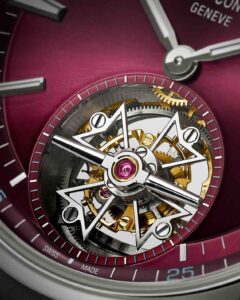
Beneath the dial, the calibre 2160 continues its quiet revolution, at just 5.65mm thick, it is among the slimmest automatic tourbillon movements in production, its peripheral oscillating weight orbiting the movement like a ring around a planet. The weight itself is guilloché, a 916/1000 gold segment that the wearer glimpses only when the watch is turned over—a private indulgence, the kind of detail that distinguishes the connoisseur from the spectator.
Eighty hours of power reserve, a frequency of 2.5 Hz, traditional and unhurried. One hundred and eighty-eight components, each finished to the standards of the Hallmark of Geneva: the mainplate circular-grained, the bridges hand-bevelled and adorned with Côtes de Genève, the screws chamfered and polished. There is no corner of this movement that has been deemed unimportant, no surface left untreated.
Selmoni, in his interview accompanying the release, addresses a question that lingers over any tourbillon presented as a sports watch: is such a complication, historically associated with fragility and pocket watches, truly compatible with an active lifestyle?
His answer is measured, as befits a man who has spent decades stewarding one of horology’s great houses. Watchmaking technology, he notes, has advanced considerably since the tourbillon’s invention in the early nineteenth century. Materials science and shock-absorption systems have transformed the regulating organs’ resilience. Add a titanium case, lightweight, robust, hypoallergenic, and the result is a tourbillon that does not demand to be handled with white gloves. It is a watch, he implies, for living.
One might add that the Overseas Tourbillon also arrives with a practicality that would have seemed improbable a generation ago. Three straps, the integrated titanium bracelet, deep red rubber, and white rubber, are interchangeable without tools, secured by folding clasps that release with the press of a push-piece. The bracelet itself incorporates a comfort-adjustment system permitting a 4mm expansion of wrist circumference, a detail that acknowledges the body’s subtle changes through a day of movement and temperature. This is not watchmaking that demands accommodation, it is watchmaking that adapts.
This Overseas Tourbillon feels, in that sense, exactly on time, and is available exclusively through Vacheron Constantin boutiques.