 Collection Pan Arab Luxury Magazine
Related Articles
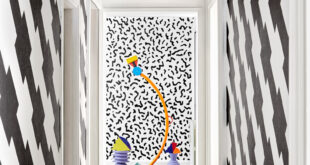
There is a particular silence that falls over a watchmaker’s bench when an engraver picks up his tools, it is not the silence of hesitation, but of absolute focus. Carlos Koo knows this silence well, he has lived inside it for nearly a decade.
In the watches industry we speak endlessly of complications, calibres, and microrotor architecture, it is refreshing to encounter an artist who reminds us that the most complex mechanism of all is the human hand. Carlos Koo, known professionally as CK Engraving, is not a watchmaker by training, he is something rarer, a self-taught metal engraver working exclusively with hammer and chisel, who found his way to horology through motorcycles, psychology, and sheer necessity.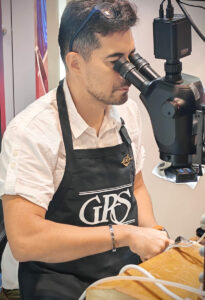
Koo’s story begins not in the ateliers of Geneva, but in his own garage in Hong Kong in 2015. He had no mentor, no apprenticeship, no tradition to inherit. What he had was a Harley-Davidson motorcycle and a stubborn refusal to accept that no one in the city could teach him the craft he admired in foreign magazines.
“People don’t appreciate easy things”, he says, a phrase that has become something close to a personal creed.
With a background in psychology and a career as an actor and model, Koo was no stranger to unstable income or fragmented schedules. Engraving began as a practical solution and a part-time pursuit he could control. But control, as any engraver will tell you, is precisely what this art demands most ruthlessly. There is no eraser and no undo, once the chisel meets the copper or the steel or the precious metal of a watch case, the line is permanent.
By 2019, his hand-engraved Harley-Davidsons were exhibited at Edinburgh Place in Central. The motorcycle community noticed. Then, slowly, so did the watch world.

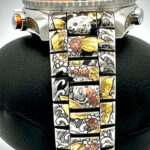
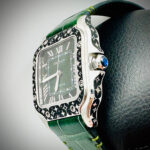
Transitioning from motorcycle metalwork to watch engraving is not a natural progression. It is a leap across an abyss. A motorcycle offers real estate, expansive surfaces that forgive slight deviations. A watch offers millimetres, a single slip, and a timepiece worth tens of thousands of dollars is irrevocably marked.
Koo admits he felt “completely lost” when he decided to engrave his first watch. The investment in professional tools had already been substantial. There was no turning back.
“Watch engraving is a process where every step must be flawless”, he explains. “Each move requires careful calculation. But the initial creative phase is still full of originality and spontaneity, much like painting or calligraphy.”
This duality is what distinguishes Koo’s work. He sketches directly onto the surface, a stage he considers the most critical of all, because once the engraving begins, there is no revision. Unlike painting, where a misplaced stroke might be painted over, metal holds every decision in permanent relief.
The luxury industry is not easily impressed by self-taught artisans, yet Koo has earned an unusual degree of institutional trust. In 2023, he collaborated with Franck Muller, the celebrated Swiss watchmaker known for its bold, avant-garde aesthetic. Koo sculpted two table clocks for the maison, one sold at the Wai Yin Association Charity Auction; the other remains in the brand’s private collection.
To have a Swiss manufacture, one that guards its heritage with justifiable pride, entrust its timepieces to a Hong Kong engraver working outside any formal atelier system is remarkable. It speaks to the quality of his hand and the clarity of his vision.
In 2024, the Hong Kong Trade Development Council invited him to display seven hand-carved timepieces at the Hong Kong Watch & Clock Fair. Later that same year, Fine Art Asia exhibited his hand-engraved desk clock. The following year, he was invited as a guest lecturer at the Chinese University of Hong Kong’s Art Department.
What stays with me, after reading Koo’s own words and reviewing his biography, is not his technical skill but his emotional intelligence, likely shaped by his psychology training. He speaks openly about needing affirmation, not only financially but emotionally. “Without recognition from others”, he says, “the path of creating art becomes even harder”.
It is a vulnerable admission in an industry that often prizes stoic confidence, but it is also profoundly honest. And honesty, like an engraved line, has a way of resonating.
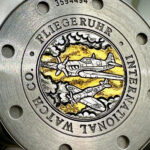
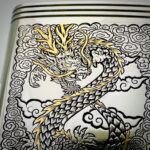
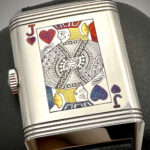
His first solo exhibition, held in 2025 at Wyndham Social in Central Hong Kong, featured six extremely rare engraved chopper plates, framed by Hollywood CG master Victor Wong, alongside over 35 engraved mixed-media prints. The exhibition was not a retrospective in the traditional sense, it was a declaration, and a statement that metal engraving, in Koo’s hands, belongs in galleries as much as on wristwatches.
Koo is mixed Chinese and Spanish, born in Hong Kong in January 1979. That hybridity is visible in his work, the disciplined precision of Chinese craftsmanship meets the passionate ornamentation of Spanish baroque, filtered through a contemporary Hong Kong sensibility. He does not replicate European engraving traditions, he has rather invented his own, alone, in a city not known for this craft.
Today, his copper plates are rare on the market, not because he limits production artificially, but because the process itself is punishingly slow. Each frame is custom-designed to reflect the theme of the artwork, incorporating diverse materials and unique structural elements. Nothing is off-the-shelf.
As a senior editor who has watched this industry evolve for two decades, I have learned to distinguish between craftsmen and artists. Craftsmen execute beautifully within established boundaries. Artists question where those boundaries should be drawn in the first place.
Carlos Koo is an artist. He is also, improbably, a pioneer. In a horological landscape increasingly dominated by CNC machining and laser engraving, he stands as a living argument for the chisel, for the hammer, for the trembling silence before the first cut, and the absolute finality of the last.
His email signature reads simply: ck engraving, but those who have seen his work up close know better, what he leaves on metal is not an engraving, it is a record of a man who refused to accept that no one could teach him and so taught himself. And in doing so, he taught the rest of us something about beauty, and courage, and the art of no return.