 Collection Pan Arab Luxury Magazine

Related Articles


In a pivotal gathering held in Porto, the Portuguese Footwear Association (APICCAPS) and the Portuguese Footwear Technological Centre (CTCP) hosted the crucial conference, “Welcome to the Industry of the Future”. The event marked the public presentation of the FAIST – Agile, Intelligent, Sustainable and Technological Factory project, a flagship initiative under Portugal’s Recovery and Resilience Plan (PRR).
The seminar underscored the strategic importance of the Portuguese footwear industry, which already boasts a formidable export-driven economy, with exports amounting to €1.9 billion and representing around 90% of the sector’s total national production. The message was clear: maintaining and enhancing this performance requires doubling down on the digital imperative and positioning Portugal internationally as a benchmark for sustainable solutions.
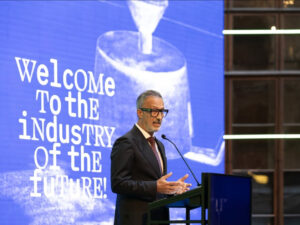
The conference served as the capstone for the FAIST Project, a massive collaborative effort involving a consortium of 45 companies, universities, and scientific entities, representing a total investment of around €50 million.
This technological vision goes far beyond general industrial modernization and is tailored to prepare the footwear and leather goods sectors for future challenges by decisively investing in digital technologies and sustainable processes and products. The core objectives driving the FAIST project—and the focus of the seminar—are multi-faceted:
- Increased Efficiency and Profitability
- Swift Response to Market Demands (Agility)
- Improvement of Working Conditions (Human-Centricity)
- Enhanced Product Differentiation (Innovation)

Sofia Moreira de Sousa, Representative of the European Commission in Portugal 
THE FOOTWEAR INDUSTRY WORLDWIDE: “PAST, PRESENT AND FUTURE”, by Vasco Rodrigues, Universidade Catolica 
A MOBILIZING VISION, by Florbela Silva, FAIST Project Coordinator
The sector is embracing Industry 5.0 concepts, leveraging technologies like Artificial Intelligence (AI), IoT, and Big Data to not just automate production (Industry 4.0), but to ensure a resilient, human-centric, and environmentally responsible supply chain, all crucial steps for an industry dedicated to sustainability leadership.
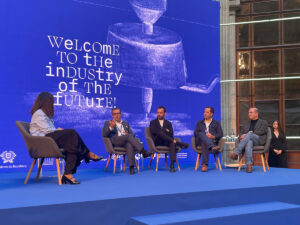
Albano Fernandes, Ricardo Costa, Ventura Correia, & Vitor Almeida.
Moderator: Claudia Pinto, APICCAPS
The seminar did not just highlight the ambition, it also addressed the reality of industrial transformation. Transitioning a traditional sector, even one as successful as Portuguese footwear, presents specific hurdles that the FAIST consortium was established to tackle:
- Human Capital Gap: A major challenge is the need for a reskilled and upskilled workforce. The introduction of sophisticated digital technologies like AI and robotics requires new competencies in data analytics, system integration, and advanced manufacturing techniques. The project implicitly stresses the importance of training programs that prepare existing workers for these high-value, human-centric roles characteristic of Industry 5.0.
- Investment and Cultural Shift: While the FAIST project secured €50 million in PRR funding, consistent private sector investment remains vital. Furthermore, the cultural shift from hierarchical, manual processes to agile, data-driven decision-making requires strong, future-oriented leadership within companies.
- Ecosystem Collaboration: The FAIST project itself is the solution to fragmented innovation. By establishing a massive consortium of 45 entities (companies, universities, and technological centers), the seminar demonstrated that no single company can achieve this transition alone. This collaboration is key to transferring knowledge from the scientific system directly into practical, industrial applications, rapidly scaling up technological adoption across the sector.

Welcome Kit 
Visist to Bolflex 
Visit to Vapesol
The funding mechanism and the focus on sustainability are defining aspects of the “Industry of the Future” agenda for Portuguese footwear. The utilization of the Recovery and Resilience Plan (PRR) funds is a powerful indicator that the government views the sector’s modernization as a strategic national priority. This investment is tied to achieving resilient growth post-pandemic and aligning with European green and digital transitions.



The ambition of APICCAPS is to position Portugal internationally as a benchmark in the development of sustainable solutions. The FAIST project’s investment in sustainable processes and products is crucial for meeting evolving global consumer demand and strict EU environmental regulations. By prioritizing agility and digital intelligence, companies can minimize waste, optimize resource use, and trace materials effectively, creating the transparent, circular models demanded by Industry 5.0.

The “Welcome to the Industry of the Future” conference was both a presentation of results and a powerful statement of intent. The success of the FAIST project and the strategic direction outlined by APICCAPS and CTCP affirm that the Portuguese footwear and leather goods sectors are not just reacting to global trends but are actively shaping their own future.
The path forward requires continued investment, sustained collaboration between industry and academia, and a commitment to both digital excellence and environmental responsibility. By leveraging the initial push from the PRR and maintaining the momentum established in Porto, this industry is poised to solidify its position as a global leader in innovation and sustainable production.