 Collection Pan Arab Luxury Magazine
Related Articles

In the heat of the Dubai summer, the Ishara Art Foundation boldly opens the doors of its gallery to the untamed spirit of the street. “No Trespassing”, curated by Priyanka Mehra, marks the Foundation’s first summer exhibition, and it lands with clarity, courage, and cultural resonance.
Running from 4 July to 30 August 2025, the exhibition draws together six UAE-based and South Asian artists who trace, tag, carve, and reconstruct the streets they’ve lived, walked, and absorbed. But this is no ordinary homage to urban life, it is a reclamation of voice, space, and authorship.
Stepping inside, viewers are immediately reminded that the gallery is no longer neutral ground. Instead, it becomes a living skin of the city, etched with memory, marked by movement, and reconfigured by human intention.
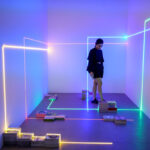
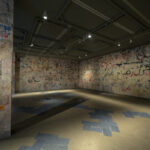
Rather than attempt to define what the street is, No Trespassing revels in its refusal to be defined. The exhibition positions the street not just as a setting but as a visceral experience, chaotic yet poetic, anonymous yet intimate, structured and spontaneous. Signposts, construction debris, pavement markings, and discarded ephemera, become the raw language through which the artists speak.
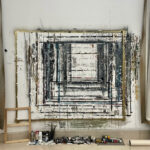
Each work presented blurs the boundaries between institutional space and public territory, suggesting that the street is not a backdrop, but a collaborator. At the entrance, H11235 (Kiran Maharjan) confronts absence head-on. Unable to be physically present, the artist creates a large-scale mixed-media abstraction that mimics the digital rendering of his original idea. It is as much about what is missing as it is about what remains, built from corrugated metal, engineered wood, and memory, it poses the question: What traces do we leave behind when we are no longer in the room?
At the far end, Rami Farook takes a scalpel to the white cube itself. By removing four square metres of the gallery wall, he exposes the hidden anatomy of the institution. It’s a gesture that is equal parts rebellion and reverence, offering the excavated fragments as a gift to Ishara’s founder and team. In doing so, Farook invites us into an ethic of shared custodianship, vulnerability, and trust.
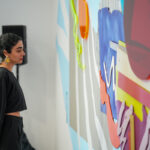
The second gallery bursts into color and gesture with Fatspatrol (Fathima Mohiuddin)’s The World Out There. Her scavenged signs and weathered posters become narrative fragments reclaimed from a system that commodifies and polices public space. Drawing directly onto the gallery walls, she assumes the role of the flâneur, transforming objects of instruction into open-ended poetry.
Nearby, Sara Alahbabi’s For a Better Modern Something is a quiet revelation. Cement blocks imprinted with urban maps form a glowing grid across the floor and wall, offering a critique of Abu Dhabi’s architectural rhythm. Alahbabi walks the city on foot, and this piece is a cartography of the unseen, revealing not just places but relationships, routes, and resistances.
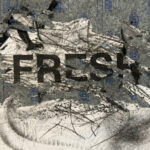
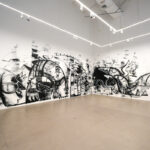
In the final gallery, Khaled Esguerra and Salma Dib collaborate in a layered, evolving installation. Esguerra’s Heritage Legacy Authentic lays copier paper, printed with sanitized promotional jargon, across the floor, inviting visitors to stomp, tear, and reveal the concealed text. Around it, Dib’s walls grow organically with traces, lettering, and textures inspired by Middle Eastern urban landscapes. The result is a palimpsest of unrest and reinvention, a visual score composed over time by many authors, all of them temporary and none erased.
What makes No Trespassing so compelling is its seamless weaving of form, theory, and activism. The artists do not simply depict the street, they re-stage it, in all its defiant honesty. Their works do not seek to beautify the urban, but to interrogate, destabilize, and inhabit it. This isn’t art that fits into frames. It seeps across boundaries, it tags the walls, it questions its own right to be there.
Curator Priyanka Mehra, whose background in public art and urban regeneration gives her a sharp curatorial lens, has constructed a show that feels at once rooted and radical. Her choice of artists, many with practices forged outside the studio and inside the chaos of the city, further highlights Ishara’s mission to center voices that complicate, contradict, and expand the South Asian and Gulf art narratives.
Supported by reframe, and accompanied by virtual and in-person programming, No Trespassing is a gesture of institutional self-awareness. In opening its white walls to marks, footsteps, and structural wounds, Ishara Art Foundation asks: What does it mean to host the street? And more importantly: Who gets to write on it? In a region where art is often pressed to perform politeness, No Trespassing is a welcome act of resistance, elegant in its execution, but fearless in its intent.
No Trespassing
📍 Ishara Art Foundation, Alserkal Avenue, Dubai
🗓️ 4 July – 30 August 2025
www.ishara.org